Complete or Targeted Removal
Choose full demolition when the entire structure must come down. Choose selective demolition when specific areas must be removed without disturbing the parts that stay.
Phoenix Demolition Co. explains that full demolition removes an entire structure to grade, while selective demolition removes only chosen rooms, systems, or materials so the rest can remain standing. For Phoenix and Maricopa County projects, that distinction changes the labor, sequencing, permitting, and protection needed around the work area.
Choose full demolition when the entire structure must come down. Choose selective demolition when specific areas must be removed without disturbing the parts that stay.
Compare access, material type, occupied areas, load-bearing conditions, utility density, and finishes that need protection before choosing a method.
A structural and hazardous-material survey comes first, followed by utility isolation, planned removal sequencing, and debris sorting before work begins.
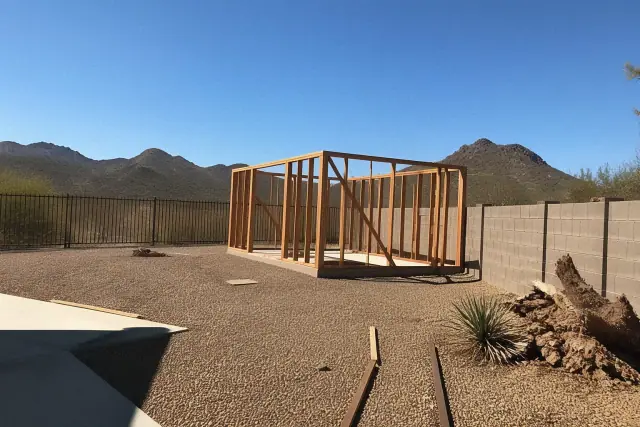
The building, foundation, disconnected utilities, and cleared footprint belong to one total-demolition scope. Seeing every element together makes a complete teardown easy to distinguish.
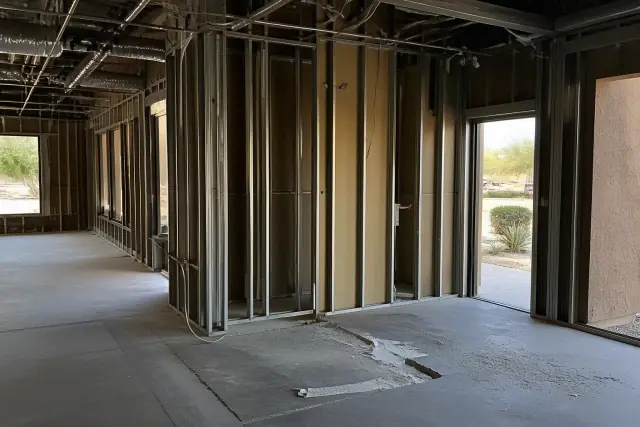
Removed walls, ceilings, cabinetry, or flooring stop at a defined boundary before the structural frame and protected finishes. Those clear limits are central to precision demolition.
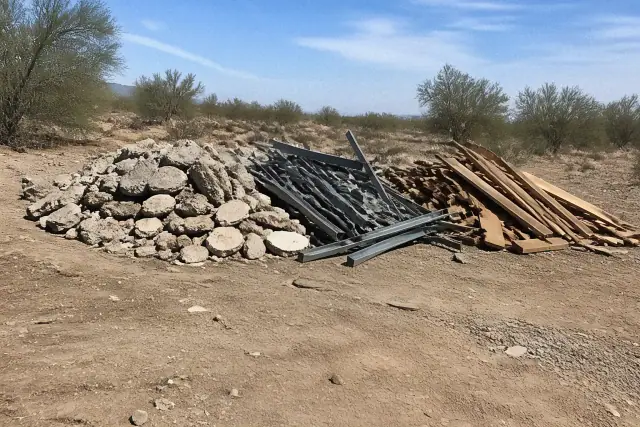
Separated material piles show how selective hauling supports recycling, salvage, and lower mixed-disposal volume. Fixtures may also be set aside for reuse.
Full demolition clears the structure to grade. Selective demolition may target a room, floor, exterior element, system, or defined material while the remaining building stays in service.
General demolition is roughly $2 to $7 per square foot, while commercial interior strip-outs often range from $4 to $15 per square foot depending on ceiling height, mechanical density, materials, and access.
A full teardown may take days to a couple of weeks. Selective removal usually takes longer because crews work in stages around protected or occupied areas.
Full demolition emphasizes clearing and recycling, while selective demolition can preserve lumber, fixtures, brick, and metal for reuse through careful disassembly and sorting.
| Factor | Full Demolition | Selective Demolition |
|---|---|---|
| Project scope | Removes the entire structure to grade. | Removes chosen rooms, systems, or materials. |
| Typical fit | Teardowns, rebuilds, and vacant-lot clearing. | Remodels, additions, and tenant improvements. |
| Work pattern | Mechanical removal on a shorter schedule. | Phased cutting, utility isolation, and protection. |
| What remains | No occupied building area remains in the work scope. | Adjacent structure and finishes stay protected. |
| Material handling | Debris is cleared with recyclable material separated. | Concrete, metal, wood, and fixtures are sorted for recovery. |
Full demolition treats the building as one removal scope, including the structure, foundation, utility disconnection, debris clearing, and grading for the next use. Excavators, skid steers, and hydraulic breakers are common when speed and complete removal are the priorities. Selective demolition uses planned cuts, hand-controlled tools, and temporary support to remove only the defined components without damaging adjoining walls, utilities, or finishes.
The decision turns on what must remain, load-bearing conditions, utility routing, hazardous materials, access, occupied space, and the condition of adjacent finishes. Older mechanical and electrical systems in Encanto and Willo may need extra routing checks, while adobe, block, and slab-on-grade construction across the Salt River Valley can affect cutting and support plans. Engineering surveys, fall protection, shoring, and dust suppression are part of OSHA 29 CFR 1926 planning, and Maricopa County's PM10 conditions make dust control especially important.
Deconstruction is different from both options because it methodically disassembles materials for reuse, which generally takes longer and costs more in labor. Properly planned selective demolition should protect the rest of the building through structural review, utility mapping, isolation, shoring, and sequenced removal. A typical scope can include surveying, utility disconnection, removal, sorting, hauling, and disposal or recycling, while hazardous-material abatement may be separate. Phoenix permits go through the City of Phoenix Development Services Department, asbestos-containing structures require Arizona Department of Environmental Quality NESHAP notification, and dust controls are required under Maricopa County Air Quality Department Rule 310.
Share which parts of the property must come out and which must remain. A project consultation can clarify the survey, permits, sequencing, protection, debris handling, timeline, and cost included in the recommended scope.